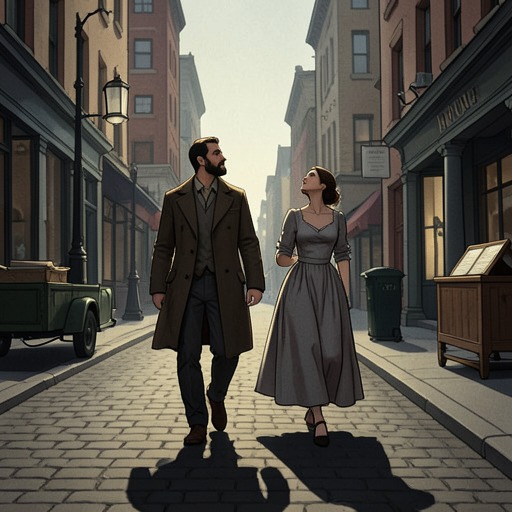
City as the source of modern art
Doctor ZhivagoYurii Zhivago’s conception of the city as the source of modern art turns the damaged urban world of the post-revolutionary years into more than a backdrop: its disorder supplies art with a new order of impressions drawn directly from life. In his notes, the wounded but still modern Moscow becomes both the subject of his writing and the condition that makes a genuinely modern art possible.
Moscow as subject and source
After returning to Moscow in 1922, Yurii found the city deserted and half destroyed. Its population had fallen, new houses were not being built, and old buildings stood unrepaired; the damage endured beyond the ordeals of the revolution’s first years. Yet this diminished city remained, in his judgment, a large modern city, and cities alone could inspire a new, truly modern art.
The claim does not depend on urban beauty or prosperity. It arises from the city’s accumulation of things and ideas, which may look incongruous or arbitrary but are, Yurii argues, not an artistic caprice. They represent a new order of impressions taken directly from life. The city’s disrepair and its modernity thus coexist: the very urban world marked by historical devastation continues to furnish art with its material and its form.
From paperwork to literary practice
This idea belongs to a wider pattern in Yurii’s working life. At a staff-room table crowded with charts and forms, he handled statistics on mortality, illness, staff earnings, political consciousness, election participation, and shortages of fuel, food, and medicine. Alongside that administrative work, he made notes for medical writing and composed fragments of a prose-and-verse journal about people who had stopped being themselves and were acting unknown parts.
Later, his articles and poems shared the theme of the city. When imagination faltered, he drew forest clearings and street intersections in the margins of his notebooks, sometimes marking them with the Moreau & Vetchinkin billboard for mechanical seeders and threshing machines. The recurring movement between streets, machinery, fragments of writing, and urban crowds makes the city not merely an object he describes but a working principle: disparate impressions can be gathered without being reduced to a single, tidy pattern.
Urban distance and provincial arrival
The novel also establishes the city through contrast. When the Zhivago family arrives in the provinces, they feel that their connection with Moscow has snapped. The railway station belongs to a different world, with its own center of gravity; its inhabitants recognize one another, and their speech, dress, food, and manners differ from those of people in the capitals. Moscow’s cultural force is registered through this separation: leaving it means entering a distinct social and imaginative territory.
The city is also shaped by communication that crosses distance imperfectly. A long, worn letter from Tonia reaches Yurii in Yuriatin after five months and passes through many hands before its recipient is found. As he reads, his awareness of Lara’s house and the people around him recedes. The episode places a private document, delayed by the fractured routes of the period, beside the larger urban network through which people, news, and experience remain connected even when the connection is fragile.
The city, history, and freedom
Yurii’s city writing belongs to his continuing effort to understand the relation between individual life and society. While composing a lament for Lara, he also completed notes on nature, humanity, and social life. He compared history’s apparently motionless course to a forest that can transform in a few spring days: growth is continuous, yet its movement cannot be caught simply by watching. The analogy gives historical change an organic scale different from the visible wreckage of the city, while keeping social transformation connected to the rhythms of living growth.
The novel’s later view of Moscow makes the city a frame for remembering as well as creating. Years after Yurii’s death, Misha Gordon and Innokentii Dudorov read a collected album of his writings at an open window above the city. Moscow no longer seems merely the stage on which his story unfolded; it appears as the chief protagonist of a long story they have reached the end of. Though victory has not brought the expected relief and freedom, the postwar period carries portents of freedom, and the two friends sense a freedom of the soul in the streets below. The city that had inspired Yurii’s modern art thus outlasts his individual experience: it holds the story, receives its writings, and becomes the setting in which his readers recognize a future still opening.